
Level is the figure that decides everything
In any business that stores or transports fuels and industrial liquids, the economic value of the product comes down to a single number: how many litres are really inside the tank. That number drives stock accounting, delivery invoicing, excise duties, refill planning and, more and more often, disputes.
Yet in many companies the level is still read with a dipstick, with an old-generation float gauge, or by simply adding up the loads and unloads recorded on paper. That approach works as long as the figures add up. When they don’t, it is almost never possible to understand why.
Level and volume monitoring in tanks, whether fixed or mounted on a road tanker, is the starting point of any wet stock management strategy and of any effort to fight losses and theft. But the quality of that monitoring depends first of all on the measurement technology chosen and on how level is converted into litres.
In this article we look at how the two technologies most widely used for continuous measurement work, magnetostrictive probes and laser level sensors, when to choose one or the other, and which factors turn a simple level reading into a reliable volume.
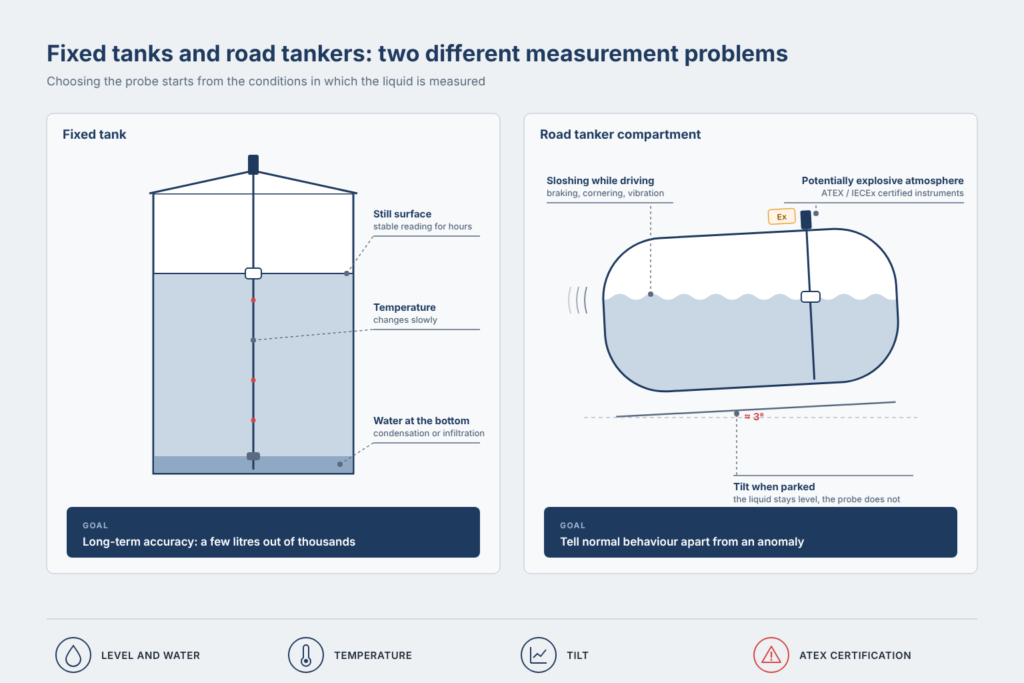
Fixed tanks and road tankers: two different measurement problems
Talking generically about “tank level measurement” risks hiding a fundamental difference. A fixed tank and a road tanker compartment raise very different physical, operational and safety issues, and the choice of probe depends largely on this.
A fixed tank, underground or above ground, is a relatively stable environment. The liquid is still most of the time, the geometry is known and temperature changes slowly. Here the challenge is long-term accuracy: spotting deviations of a few litres out of thousands, telling a slow leak apart from normal thermal contraction, noticing water building up at the bottom. Think of company fuel depots, agricultural and heating oil tanks, industrial tank farms, chemical and additive tanks, and also the thousands of small, isolated tanks scattered across the territory that are hard to supervise.
A road tanker, on the other hand, is an environment in motion. The product sloshes when braking and cornering, the vehicle tilts when parked on a yard that is not perfectly level, vibrations are constant and each compartment has its own geometry. Safety constraints come on top: the compartment of a tanker carrying fuel is a potentially explosive atmosphere, and the instrumentation must be ATEX / IECEx certified for installation in the classified zone. Here the challenge is to distinguish what is physiological (sloshing, thermal expansion during the trip) from what is not: a drop in level during an unplanned stop.
In both cases the final goal is the same: knowing at any moment how much product there is, where it is and whether its behaviour is consistent with the recorded operations.
The magnetostrictive probe: accuracy and long-term stability
The magnetostrictive level probe is today the benchmark for precision volumetric monitoring, both in fixed tanks and in road tanker compartments. Its operating principle explains why.
Inside a vertical rod immersed in the liquid runs a wire made of magnetostrictive material. A float containing a permanent magnet slides along the rod and follows the product surface. The electronics in the probe head send a short current pulse through the wire: when the magnetic field generated by the pulse meets the field of the float’s magnet, the wire undergoes a tiny twist that travels back to the head as a mechanical wave. By measuring the time between sending the pulse and the return of the wave, the system calculates the position of the float, and therefore the level, with great precision.
The result is an absolute, repeatable, drift-free measurement: there is nothing to recalibrate periodically, because the reading depends on a propagation time rather than on an analogue quantity subject to ageing. Achievable resolutions are in the order of tenths of a millimetre, which on a large-diameter tank corresponds to just a few litres.
There is another advantage that makes all the difference in wet stock management. Two floats can slide on the same rod: one follows the product surface and a heavier one settles at the interface between fuel and water at the bottom. The probe therefore measures product level and water level at the same time, essential information both for fuel quality and for detecting fraudulent water additions. Temperature sensors at different heights are also integrated along the rod, and they are indispensable for converting volume to reference conditions. Some configurations also add product density measurement.
The main limitation is mechanical: the probe is in contact with the liquid and must be sized to the depth of the tank. This makes it the ideal solution where accuracy is the priority: tank farms, depots, filling stations, tanks of high-value products and road tanker compartments, where ATEX/IECEx certified versions allow installation in classified zones.
LSI Industry distributes, in partnership with FAFNIR, a range of magnetostrictive level sensors for level, overfill and density measurement, and can also integrate sensors already owned by the customer.
The laser level sensor: non-contact measurement and quick installation
The laser level sensor works on the opposite principle: it never touches the liquid. Installed on top of the tank, it emits a beam of light towards the product surface and measures the time the light takes to come back after reflection. From the distance between sensor and surface, and knowing the tank height, the level is obtained.
Having no immersed parts brings very practical advantages. There are no floats that can jam, no rods to size to the tank depth, no mechanical parts in contact with aggressive, viscous or dirty products. Installation is quick and minimally invasive: in many cases a threaded fitting on the tank lid is all it takes. The same sensor can be used on tanks of different heights, which simplifies stock and spare-part management.
These features make laser particularly attractive for remote monitoring of tanks spread across the territory: diesel tanks at farms, construction sites and small users, lubricant, additive or AdBlue tanks, isolated depots without a power supply. In these settings the goal is not so much accuracy to a tenth of a millimetre as knowing every day how much product there is, receiving an alarm when the level falls below a threshold or drops abnormally, and planning refills rationally.
Like any optical technology, laser requires some care: persistent surface foam, dense vapours or condensation on the optics can disturb the reflection, and the water/product interface measurement typical of a magnetostrictive probe is not available. This is why laser and magnetostrictive are not competing technologies but complementary tools, to be chosen according to the application.
The LLC laser level controller developed by LSI Industry was designed precisely for these scenarios. It screws directly onto the tank lid with an integrated ¾” fitting, measures level and volume using a tank calibration table, manages four configurable alarm thresholds and sends data to a web portal without a physical SIM. A small solar panel with a long-life battery makes it self-sufficient even where there is no power. The current version is not ATEX certified: it is intended for tanks in non-classified areas, and an ATEX version is in preparation.
Laser or magnetostrictive: which one to choose
The choice does not depend on which technology is “better” in absolute terms, but on what needs to be monitored, where, and with what level of accuracy. The table summarises the criteria that usually guide the project.
| Criterion | Magnetostrictive probe | Laser sensor |
|---|---|---|
| Principle | Magnetic float on an immersed rod, propagation time of a torsional wave | Non-contact optical measurement of the distance to the surface |
| Accuracy | Very high (tenths of a mm), stable over time | Suited to stock and threshold monitoring |
| Water at the bottom | Measured with a second float | Not measured |
| Temperature / density | Can be integrated on the same rod | Requires separate instrumentation |
| Installation | Rod sized to the tank depth | Fitting on the lid, no immersed parts |
| Moving environment (road tanker) | Suitable, with tilt compensation | Less suitable |
| Typical applications | Road tankers, depots, filling stations, tank farms, high-value products | Isolated and distributed tanks, remote stock monitoring |
In more complex projects the two technologies coexist: magnetostrictive probes where economic value and fraud risk are concentrated, laser sensors to extend monitoring to a widespread network of peripheral tanks at a contained cost.
From level to volume: where errors hide
A probe measures a height. What the company cares about, however, is litres. The conversion from level to volume is where most errors concentrate, and therefore also most of the blind spots in which losses and theft can go unnoticed.
The first element is the tank’s calibration table, which associates each height with the corresponding volume. A horizontal cylindrical tank, a road tanker compartment with a shaped bottom or a tank deformed over the years do not have a linear relationship between level and volume. An inaccurate table produces a systematic error that no probe, however precise, can correct.
The second element is temperature. Fuels expand with heat: for diesel the change is around 0.08% per degree Celsius, and higher for petrol. In a 30,000-litre tank, a ten-degree difference between loading and unloading is worth about 240 litres of diesel that “appear” or “disappear” without anyone touching the product. This is why volumes are converted to the reference temperature of 15 °C: without this compensation it is impossible to distinguish a physical phenomenon from a real shortfall.
The third element, specific to road tankers, is vehicle tilt. A few degrees of slope on the yard shift the liquid towards one end of the compartment and alter the reading of a probe installed at a fixed point. A measurement system for road tankers must therefore detect the tilt angle and correct the volume calculation accordingly.
Finally there is water. Whether it comes from condensation, infiltration or a deliberate addition to compensate for a withdrawal, water at the bottom alters the apparent volume of the product. Only a measurement that distinguishes the two layers tells you how many litres of fuel are really there.
These four factors explain why volumetric monitoring is not just about choosing the probe. It is the combination of sensor, calibration, compensation and data processing that determines how reliable the system is.
Conclusion
Magnetostrictive probes and laser sensors meet different needs. The former delivers the accuracy and the wealth of information (water, temperature, density) needed where product value and fraud risk are highest: road tankers, depots, tank farms. The latter brings continuous monitoring to networks of isolated tanks as well, at a contained cost and with immediate installation.
In both cases the probe is only the first link in the chain. Calibration, temperature and tilt compensation and the distinction between product and water are what turn a height into a reliable volume. How that volume then becomes a tool against theft and losses is explained in our article on fuel theft and losses and continuous level monitoring.
LSI Industry designs and integrates measurement, monitoring and anti-fraud systems for road tankers and fixed tanks, from probe selection to the supervision portal. If you are assessing how to protect your fuel or industrial liquid stocks, contact our team for an analysis of your application.
FAQ
What is the difference between a magnetostrictive probe and a laser level sensor?
A magnetostrictive probe is immersed in the liquid and detects the position of a magnetic float along a rod, with very high accuracy and the ability to also measure water at the bottom, temperature and density. A laser sensor measures the distance to the product surface without contact: it is easier to install and ideal for remote monitoring of distributed tanks, but it does not detect the water/product interface.
Why does volume measurement need temperature compensation?
Because fuels expand and contract with temperature. Without converting volumes to a reference temperature, normally 15 °C, variations of hundreds of litres in a tank can be mistaken for losses or, conversely, hide a real shortfall.
Can level probes detect water added to a tank?
Yes. Magnetostrictive probes fitted with a second float measure the water level at the bottom separately from the product level. A sudden increase in water, especially together with a drop in product, is a typical sign of an attempt to cover up a withdrawal.
Do probes installed on road tankers need ATEX certification?
For compartments carrying fuels and flammable liquids, instrumentation installed in classified zones must be certified for potentially explosive atmospheres, under the ATEX directive and the international IECEx scheme. LSI Industry’s DLC-01 system is ATEX and IECEx certified for zone 1.
Can a laser sensor be installed on an existing tank?
Yes. A laser sensor has no immersed parts and is mounted on top of the tank: for LSI Industry’s LLC controller, a ¾” fitting on the lid is enough. This also makes it suitable for retrofitting tanks already in service, provided they are installed in non-classified areas.
How accurate is a magnetostrictive probe?
Magnetostrictive probes achieve resolutions in the order of tenths of a millimetre, stable over time and without periodic recalibration. Volume accuracy, however, also depends on the quality of the tank calibration table and on temperature compensation.