
Small shortfalls, big costs
In the management of fuels and industrial liquids, the most expensive losses are rarely the ones that make the news. Far more often, a few litres simply go missing: a withdrawal during a road tanker stop, a seeping joint in an underground tank, a construction-site tank emptied overnight. Taken individually they seem negligible; added up over a year, a fleet or a network of depots, they become a significant item on the balance sheet.
On top of this come less visible costs: the time spent reconstructing inventory differences, disputes with customers and hauliers, environmental and insurance risks, and the loss of credibility of internal procedures.
The starting point for fighting fuel theft and losses is always the same: knowing at any moment how much product is in the tank, where it is and whether its behaviour is consistent with the recorded operations. In this article we look at how continuous level and volume monitoring, on road tankers and on fixed tanks, turns a measurement into a practical tool for wet stock management and fraud prevention.
If you are interested in the comparison between measurement technologies instead, we have devoted a separate article to magnetostrictive and laser level sensors.
Why comparing loads and deliveries is not enough
Many companies still check their stocks by comparing two numbers: the volume loaded at the depot and the volume delivered to the customer, or a tank’s stock at the start and end of the month. It is a necessary check, but it has a structural limitation: it sees the final result, not what happened in between.
If 40 litres are missing at the end of a trip, it is impossible to tell whether this is a thermal effect, a measurement error or a theft, let alone when and where it happened. Those who steal product know this well: small withdrawals stay within the tolerance normally accepted between loading and delivery, or are compensated with water to bring the level back to the expected value.
Then there is temperature. Fuels expand with heat, and in a 30,000-litre tank a few degrees of difference are enough to make hundreds of litres of diesel appear or disappear without anyone touching the product. Unless volumes are converted to the reference temperature of 15 °C, every deviation remains ambiguous.
To remove this ambiguity, three things are needed: a continuous measurement, not only at the start and the end; a compensated measurement for temperature, tilt and the presence of water; and the correlation of every change with its context: time, position, operations in progress.
Road tankers: continuous measurement and geo-referenced events
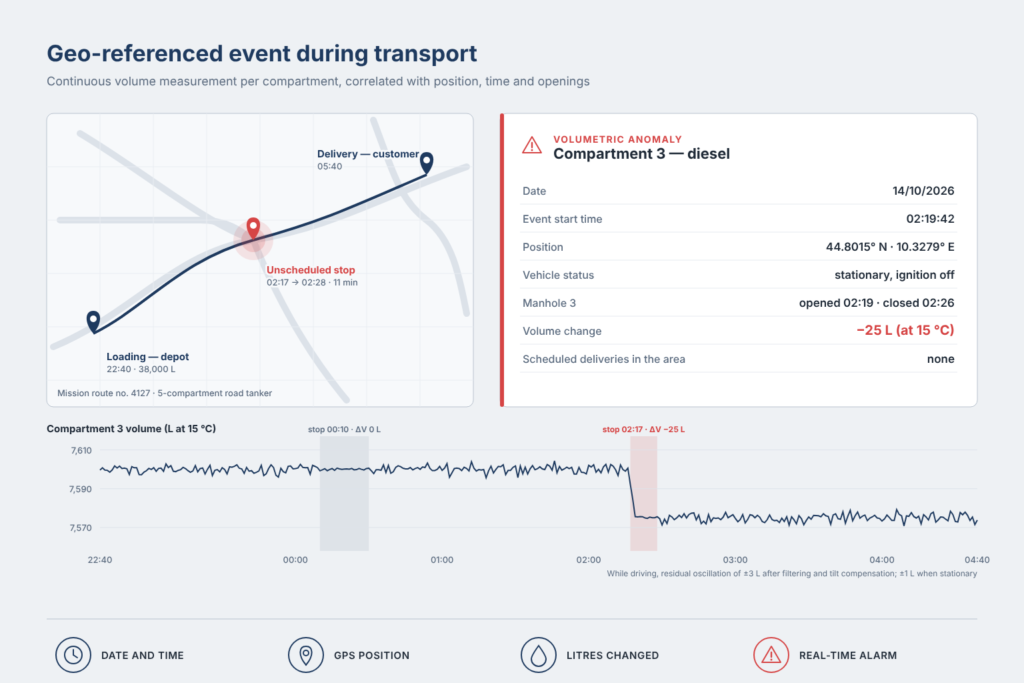
Continuous level measurement during the trip overturns the logic of end-of-mission checks. A probe installed in each compartment records the volume trend throughout the transport and links it to every relevant event: a manhole opening, a valve operation, a vehicle stop. When the volume drops at a time when no delivery is planned, the event is reported with date, time, GPS position and number of litres changed.
It is the geo-referencing of events that turns a technical figure into usable information. A 3,000-litre delivery at the planned drop-off point is a routine operation; a 25-litre drop at two in the morning in an unscheduled lay-by is an anomaly worth checking. The fleet manager no longer has to reconstruct an inventory difference after the fact: the event arrives when it happens, with everything needed to assess it.
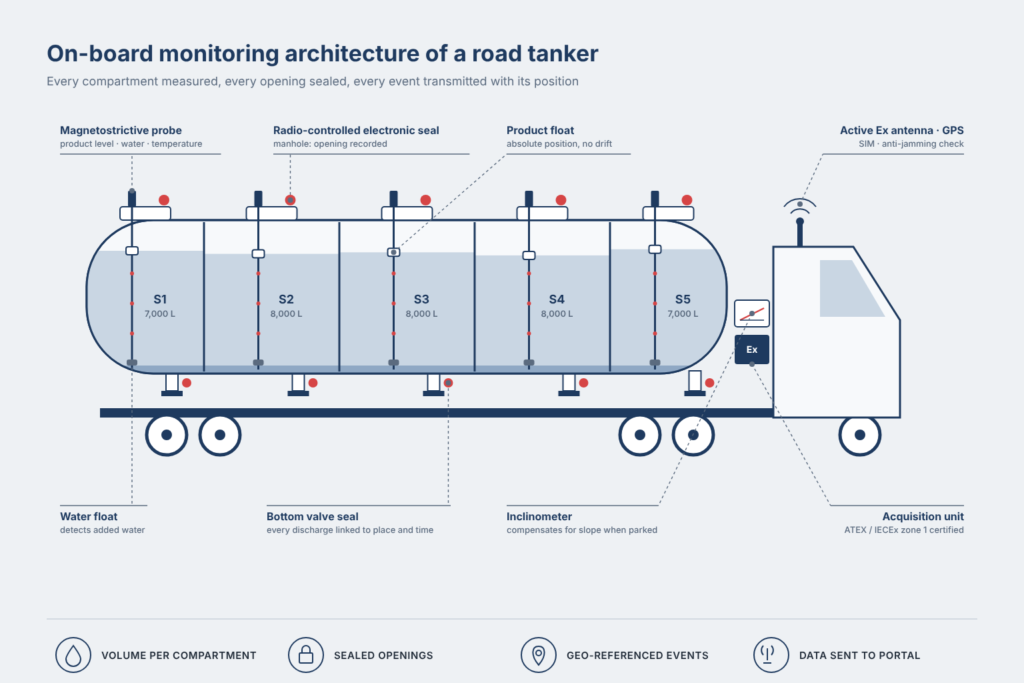
For this to work, the measurement must be able to tell normal behaviour from anomalies. The system has to compensate for vehicle tilt, which on a sloping yard shifts the liquid and alters the reading; it has to convert volumes to the reference temperature; and it has to detect water at the bottom, to expose attempts to cover up a withdrawal by topping up with water. Anti-jamming checks against GPS signal jammers and electronic sealing of access points complete the picture.
LSI Industry’s DLC-01 dynamic volume monitoring system integrates exactly these functions: management of up to 10 compartments, tilt compensation, density measurement, detection of added water and online transmission of geo-referenced events, with ATEX and IECEx certification for installation in zone 1. Combined with the ATS anti-fraud system with radio-controlled sealing, it correlates every opening with the volume change that followed it.
Finally, there is an effect that is harder to measure but just as important: deterrence. When those operating the vehicle know that every level change is recorded and located, the temptation to attempt small withdrawals drops sharply. For more on prevention strategies in transport, see our article on how to prevent fuel theft during road tanker transportation.
Fixed tanks: slow leaks, theft and wet stock management
If theft is the main risk on a road tanker, in a fixed tank the most insidious enemy is the slow leak. A seeping joint, a corroded pipe, a tank bottom that has started to fail: leaks of a few litres a day that can go on for months before becoming visible. Meanwhile they distort the inventory and, in underground tanks, contaminate the soil, with environmental and legal consequences far more costly than the lost product.
Wet stock management tackles the problem by systematically comparing what the tank should contain (opening stock, plus deliveries, minus dispensing) with what the probe actually measures, at equal temperature. Under normal conditions the difference fluctuates around zero; when it starts to grow steadily in the same direction, the system flags an anomaly. This approach catches a leak while it is still small, instead of discovering it at stock-taking or, worse, through an environmental incident.
The quality of reconciliation depends directly on the quality of the measurement. A magnetostrictive probe, with its long-term stability and built-in temperature and water measurement, allows tight alarm thresholds and keeps false alarms to a minimum. During idle periods, for example overnight at depots that are not dispensing, the compensated level must stay constant: any persistent drop is a clue to investigate.
The same reasoning applies to theft from fixed tanks, a widespread problem on construction sites, farms and unattended depots. A level drop recorded at night, or at a time when no dispensing is logged, is reported immediately via web or e-mail. For a network of peripheral tanks, a self-powered laser sensor such as the LLC laser level controller makes this monitoring economically viable too, with the added benefit of being able to plan refills based on actual consumption and streamline delivery rounds.
For a deeper dive into the topic, see our article Wet Stock Management: the hidden problem costing millions to the liquid industry.
How to set up an anti-theft and anti-leak project
An effective monitoring system does not start from a probe catalogue but from an analysis of the operating context. The first question to ask is what the main risk is: theft during transport, a slow leak at a depot, lack of visibility over a network of peripheral tanks, or a combination of these. The answer determines the measurement technology, the data acquisition frequency and the alarm logic.
The second step concerns the installation environment: type of liquid, geometry of tanks or compartments, classification of explosion-risk zones, availability of power and network coverage. A fuel road tanker will require ATEX/IECEx instrumentation, tilt compensation and mobile transmission; a diesel tank on a farm can rely on a self-contained, solar-powered sensor.
The third step is often underestimated: deciding who receives the information and what they must do with it. A portal showing thousands of readings is of no use to anyone; a system that alerts the logistics manager only to anomalous events, with location and quantity, makes timely action possible. Integration with existing company systems, from fleet management to the warehouse management system, should be planned from the start.
Finally, scalability. Many companies start with a pilot on a few vehicles or a single depot and then extend monitoring to the whole network. An architecture designed to grow, with coordinated sensors, electronics and software, avoids ending up with heterogeneous solutions that do not talk to each other: exactly the kind of gap that those who steal product quickly learn to exploit.
Conclusion
Fuel theft and losses have one thing in common: they thrive in the time window when nobody is measuring. An end-of-trip or end-of-month check comes when the damage is already done and, above all, when it is no longer possible to understand what happened.
Continuous level and volume monitoring, compensated and correlated with position, time and operations, closes that window. On road tankers it pinpoints a withdrawal at the moment and place it occurs; on fixed tanks it catches a leak while it is still small, or a night-time theft before it happens again. In both cases it reduces disputes, improves traceability and discourages misconduct.
LSI Industry designs and integrates measurement, monitoring and anti-fraud systems for road tankers and fixed tanks, from probe selection to the supervision portal. If you are assessing how to protect your fuel or industrial liquid stocks, contact our team for an analysis of your application.
FAQ
How can fuel theft from a road tanker be detected?
By continuously measuring the volume in each compartment during the trip and linking every change to date, time and GPS position. A volume drop occurring away from planned delivery points, or coinciding with an unauthorised opening, is reported as an anomaly in real time.
Isn’t GPS enough to protect the load?
No. GPS tells you where the vehicle is, but not whether the volume carried has changed. Only the combination of position and continuous level measurement shows whether a withdrawal took place during a stop.
How can water added to a tank be detected?
With magnetostrictive probes fitted with a second float, which measure the water level at the bottom separately from the product level. A sudden increase in water, especially together with a drop in product, is a typical sign of an attempt to cover up a withdrawal.
What is wet stock management?
It is the set of measurements, procedures and analyses used to accurately control stocks of stored or transported liquids, reconciling measured volumes with the volumes moved in order to promptly detect leaks, measurement errors and theft.
How can a slow leak in an underground tank be detected?
By comparing over time the measured volume, compensated for temperature, with the volume expected from deliveries and dispensing. A difference that keeps growing in the same direction, or a drop during idle periods, points to a possible leak that needs checking.